THE SUN
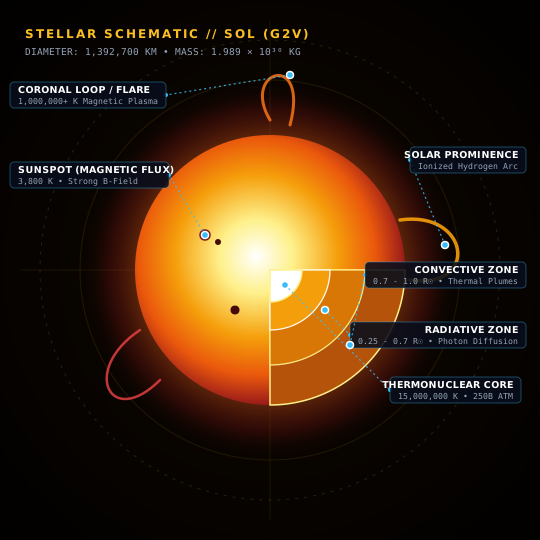
At the gravitational heart of our solar system sits the Sun — a titanic, churning sphere of incandescent plasma powered by thermonuclear fusion. It accounts for 99.86% of the entire mass of the solar system and anchors every planet, asteroid, and comet in its gravitational grip.
- ✦ Every single second, the Sun fuses 600 million metric tons of hydrogen into 596 million tons of helium, converting the missing 4 million tons directly into pure energy (E = mc²).
- ✦ Photons born in the core take between 100,000 to 170,000 years to slowly bounce through the dense radiative zone, but once they reach the surface, they zip across the vacuum of space to your eyes in just 8 minutes and 20 seconds.
- ✦ The Sun's outer atmosphere (the corona) is paradoxically superheated to over 1,000,000 °C — hundreds of times hotter than the visible surface (5,500 °C) — a persistent astrophysical mystery driven by magnetic reconnection.
Astrophysical Mechanics & Field Notes ▼
The Sun is currently in the stable main-sequence phase of its life. In approximately 5 billion years, it will exhaust its hydrogen core, expand into a swollen Red Giant star swallowing Mercury and Venus, and ultimately shed its outer layers into a glowing planetary nebula, leaving behind a superdense Earth-sized White Dwarf core.
MERCURY
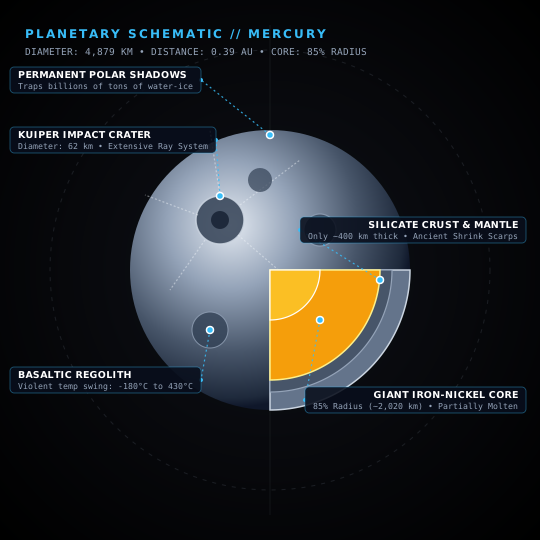
Mercury is a sun-blasted, crater-riddled pebble of rock hurtling through the Sun's deepest gravitational well. Having virtually no atmosphere to trap heat or shield its crust, it experiences the most violently extreme temperature swings of any planet in the solar system.
- ✦ Mercury has a massive metallic core that comprises nearly 85% of the planet's radius. As this titanic core cooled over billions of years, the planet literally shrank, creating towering fault scarps thousands of feet high.
- ✦ Despite temperatures that can melt lead on its day side, deep craters at Mercury's north and south poles are permanently shielded from sunlight and contain billions of tons of ancient water ice.
- ✦ Because of its eccentric orbit and 3:2 spin-orbit resonance, an observer on Mercury would see the Sun rise, stop in the sky, reverse its course, and then resume moving forward!
Astrophysical Mechanics & Field Notes ▼
Mercury’s perihelion precession was one of classical Newtonian physics' greatest unsolved puzzles. It wasn't until Albert Einstein applied General Relativity in 1915 — showing that the Sun’s immense mass actually warps spacetime around Mercury — that its exact orbital path was finally explained.
VENUS
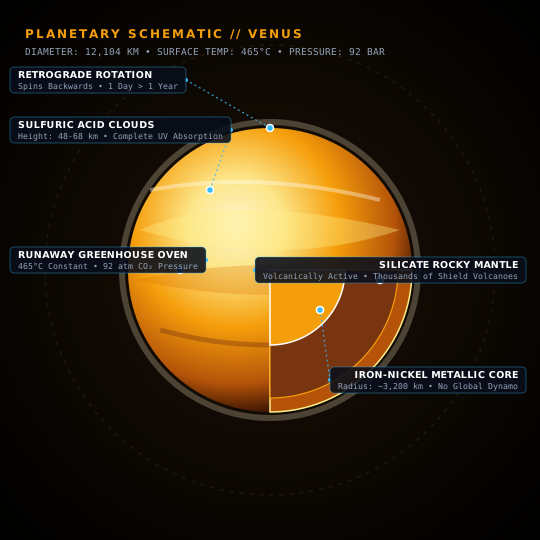
Shrouded in an impenetrable veil of pale sulfuric acid clouds, Venus is Earth's twisted twin. Though roughly identical in size, composition, and density to Earth, catastrophic ancient climate feedback loops turned it into a high-pressure volcanic inferno.
- ✦ Venus is the hottest planet in the Solar System, even hotter than Mercury. Its dense carbon dioxide atmosphere traps heat so efficiently that day and night are equally scorching across the entire globe.
- ✦ Venus spins backward (retrograde) compared to nearly all other planets. The Sun rises in the west and sets in the east, and one Venusian day is longer than an entire Venusian year!
- ✦ Russian Venera landers that touched down on Venus survived only for roughly an hour before their titanium hulls were crushed by the immense atmospheric pressure and melted by the searing heat.
Astrophysical Mechanics & Field Notes ▼
Planetary scientists believe that billions of years ago, Venus may have had temperate liquid water oceans and a benign atmosphere. As solar luminosity increased, evaporating water created a moisture greenhouse, accelerating evaporation until oceans boiled away and ultraviolet radiation dissociated water molecules into space.
EARTH & THE MOON
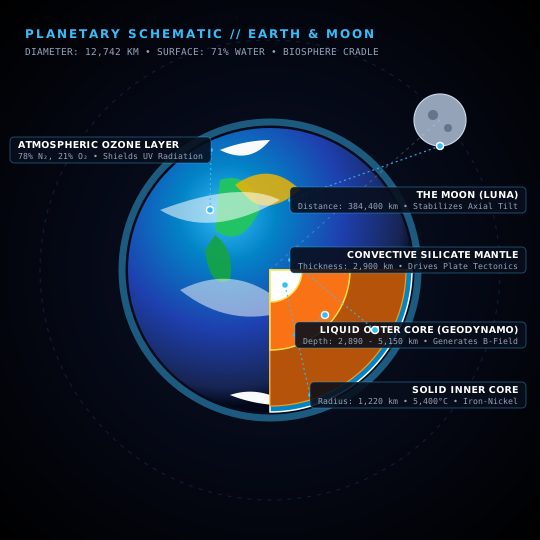
Suspended in the silent cosmic void, Earth is a fragile, breathtaking oasis: the only known harbor of life, consciousness, and liquid surface oceans in the cosmos. Accompanied by our uncommonly large Moon, it represents the goldilocks triumph of stellar physics.
- ✦ If the history of Earth were compressed into a single 24-hour day, human civilization would only occupy the final 0.2 seconds before midnight.
- ✦ The Moon stabilizes Earth's axial tilt between 22.1° and 24.5°. Without the Moon's gravitational tidal brake, Earth's tilt would wobble chaotically, producing catastrophic swings between planetary ice ages and super-furnace climates.
- ✦ Looking back at Earth from 6 billion kilometers away, Voyager 1 captured Earth as a single, fragile blue pixel — immortalized by Carl Sagan as 'a mote of dust suspended in a sunbeam.'
Astrophysical Mechanics & Field Notes ▼
Earth’s dynamic molten iron outer core generates a robust magnetosphere through geodynamo action. This invisible magnetic shield deflects the Sun’s ionizing solar wind and cosmic rays, preserving our delicate atmosphere and allowing life to evolve unmolested on dry land for over 500 million years.
MARS
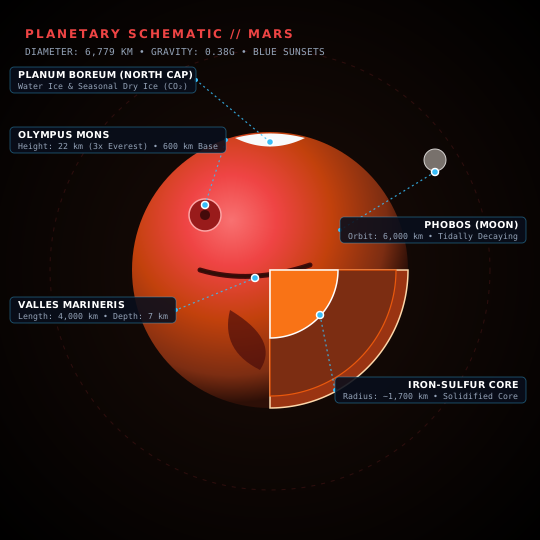
Rust-red, frigid, and swept by global dust storms, Mars is a world of ancient rivers, dry lake beds, and colossal geological monuments. Its rusted iron oxide surface holds tantalizing clues to whether life ever arose beyond our home planet.
- ✦ Mars is home to Olympus Mons, the largest volcano in the Solar System. At 22 km (13.6 miles) high, it towers three times higher than Mount Everest and covers an area the size of France.
- ✦ The colossal canyon system Valles Marineris spans over 4,000 km in length and plunges 7 km deep — wide enough to span the entire continental United States from New York to San Francisco.
- ✦ Sunsets on Mars glow with a ghostly, surreal blue halo around the Sun, caused by fine dust particles scattering reddish wavelengths outward while allowing blue light to penetrate directly through.
Astrophysical Mechanics & Field Notes ▼
Four billion years ago, Mars had a thick atmosphere, a global magnetic field, and vast rivers and lakes. When Mars’s small core cooled and solidified, its magnetic shield collapsed, allowing the solar wind to strip its atmosphere away into space over hundreds of millions of years.
THE ASTEROID BELT & CERES
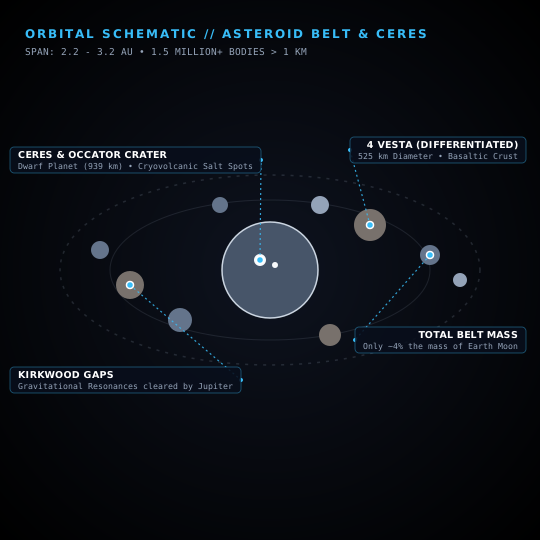
Stretching across the gulf between Mars and Jupiter lies the Asteroid Belt: millions of tumbling boulders, metallic fragments, and primitive dwarf planet Ceres. These are the pristine building blocks of planets that never were.
- ✦ Contrary to science-fiction films where spaceships dodge densely packed boulders, the Asteroid Belt is virtually empty space: spacecraft fly straight through without having to alter course once.
- ✦ Ceres is so large it has collapsed into a spherical dwarf planet under its own gravity. NASA's Dawn spacecraft revealed it possesses a subsurface reservoir of briny water and cryovolcanoes that erupt icy salt slush.
- ✦ The immense gravitational resonance of Jupiter continually stirred this zone, accelerating the boulders to speeds so high that collisions smashed them apart rather than allowing them to accrete into a ninth planet.
Astrophysical Mechanics & Field Notes ▼
Meteorites that fall to Earth from the Asteroid Belt provide direct chemical samples of the solar nebula as it existed 4.567 billion years ago. Metallic asteroids like 16 Psyche are thought to be the exposed iron-nickel cores of shattered ancient protoplanets.
JUPITER
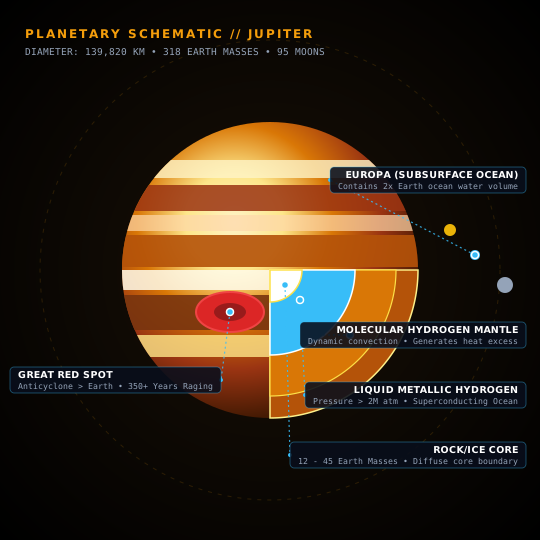
Jupiter is an awe-inspiring, turbulent behemoth. Containing more than twice the mass of all other planets in the Solar System combined, its immense gravity acts as a cosmic vacuum cleaner, deflecting comets and shaping the destiny of the inner worlds.
- ✦ The Great Red Spot is a colossal anticyclonic storm larger than Earth that has raged continuously across Jupiter's southern hemisphere for more than 350 years, with winds clocking 430 km/h.
- ✦ Deep inside Jupiter, pressures reach millions of atmospheres. At these unfathomable depths, hydrogen gas is compressed into liquid metallic hydrogen — an exotic state of matter that conducts electricity like liquid copper.
- ✦ Its moon Europa contains a global subsurface saltwater ocean beneath its icy shell that holds more than twice the water of all Earth's oceans combined, considered one of the prime targets in the search for alien life.
Astrophysical Mechanics & Field Notes ▼
Jupiter has a magnetosphere so gargantuan that if it were visible in the night sky from Earth, it would appear larger than the full Moon. Its intense radiation belts trap high-energy electrons with enough power to fry unshielded spacecraft electronics within hours.
SATURN
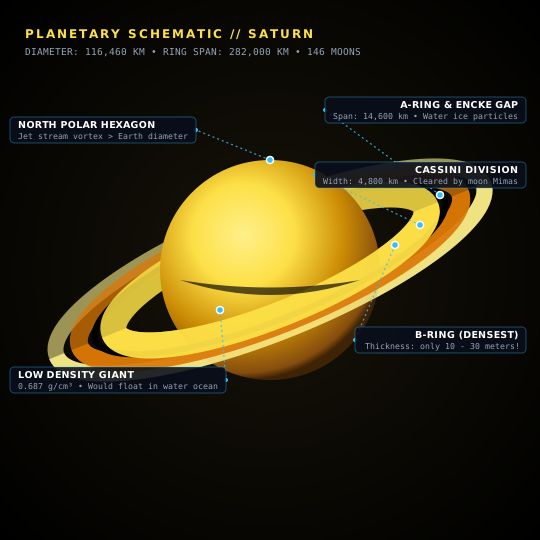
Adorned with a dazzling, impossibly broad disc of icy rings, Saturn is the undisputed crown jewel of our planetary system. Beneath its golden cloud bands lies a planet so light and gaseous that it would literally float in a cosmic ocean of water.
- ✦ Saturn's rings are over 280,000 kilometers wide, yet on average they are only as thick as a two-story building (10 to 30 meters). They are composed of 99% pure water ice particles ranging from tiny frost specks to house-sized icebergs.
- ✦ At Saturn's north pole sits a geometric anomaly: a permanent hexagonal jet stream storm. Each of the six sides is wider than planet Earth, rotating in synchrony with Saturn's deep radio emissions.
- ✦ Its giant moon Titan has a dense nitrogen atmosphere and rivers, lakes, and rainfall of liquid methane and ethane, with water-ice mountains that are frozen as hard as steel granite.
Astrophysical Mechanics & Field Notes ▼
Data from the Cassini spacecraft revealed that Saturn is actively 'drinking' its own rings. Known as 'ring rain', water ice particles are being pulled into Saturn's upper atmosphere by gravity and electromagnetic forces at a rate that could cause the rings to completely vanish within 100 to 300 million years.
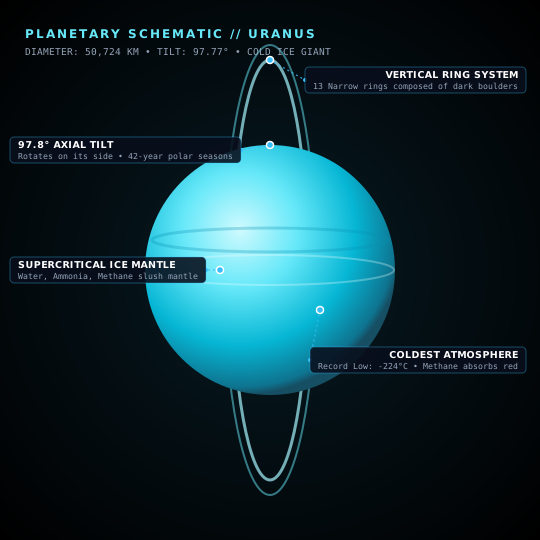
URANUS
Pale, ethereal, and silent, Uranus is an icy world that defies planetary convention. Unlike any other planet in the solar system, it orbits the Sun tilted completely on its side, rolling like a celestial bowling ball through the freezing dark.
- ✦ Because Uranus is tilted at 98 degrees, its poles point almost directly at the Sun. Each pole endures 42 continuous years of blinding summer sunlight, followed by 42 years of pitch-black, frozen polar winter.
- ✦ Uranus holds the record for the coldest recorded planetary temperature in the Solar System (-224°C), even colder than more distant Neptune, because it lacks an internal heat engine.
- ✦ The planet’s magnetic poles are misaligned by 59 degrees from its rotational axis and shifted off-center, causing its magnetosphere to twist and corkscrew through space like a chaotic tumbleweed.
Astrophysical Mechanics & Field Notes ▼
Astrophysicists believe Uranus's sideways orientation was caused by a cataclysmic collision during the chaotic early solar system: an impactor roughly one to two times the mass of Earth struck the young protoplanet, knocking it onto its side and stripping much of its primordial internal heat.
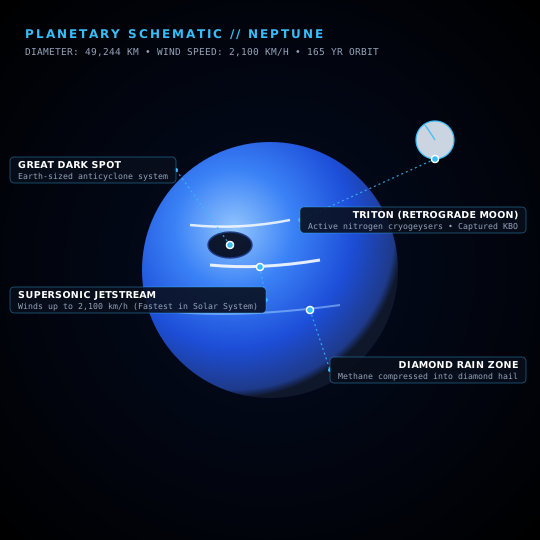
NEPTUNE
A luminous, electric-blue world situated at the precipice of deep space, Neptune is the windiest world in the Solar System. Despite receiving only 0.1% of the sunlight Earth enjoys, its stormy atmosphere churns with unimaginable kinetic fury.
- ✦ Neptune's supersonic winds blow at more than 2,100 km/h — three times faster than jet airliners and five times faster than the most violent tornadoes ever recorded on Earth.
- ✦ Under the crushing pressures of thousands of kilometers of mantle, methane gas is squeezed and pyrolyzed into pure carbon crystals: it literally rains real diamonds down toward the planet’s core.
- ✦ Its largest moon, Triton, orbits backward (retrograde) and features active nitrogen geysers that spew dark plumes miles into the vacuum.
Astrophysical Mechanics & Field Notes ▼
Neptune was the first planet discovered through pure mathematical deduction rather than telescopic observation. Astronomers noticed unexplained gravitational wobbles in Uranus's orbit and calculated the exact sky coordinates where an unknown eighth planet had to be, finding Neptune within 1 degree of the prediction.
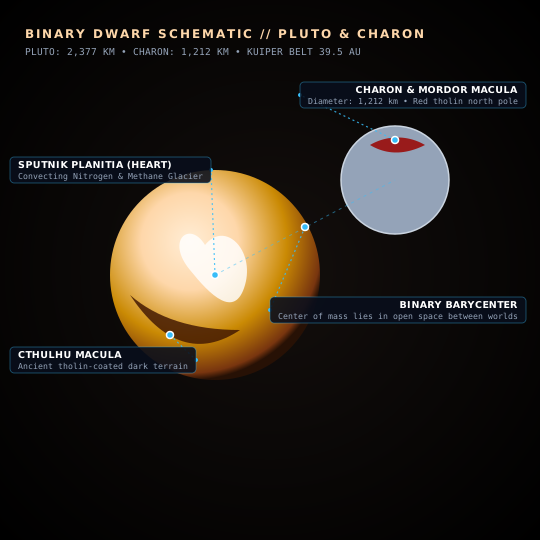
PLUTO & THE KUIPER BELT
Far beyond the gas giants lies the Kuiper Belt: a vast, frozen twilight zone of primitive ice worlds. At its center stands Pluto and its giant companion Charon — a dynamic double-planet system featuring towering water-ice mountains and glowing nitrogen glaciers.
- ✦ Pluto features a vast, bright ice plain named Sputnik Planitia, shaped like a giant glowing heart. It is a slow-convecting glacier of pure nitrogen and carbon monoxide ice that actively resurfaces itself.
- ✦ Pluto and Charon are gravitationally locked in a true binary orbit: the center of mass (barycenter) lies in open space between them, and the same faces of both worlds permanently stare at each other.
- ✦ When NASA's New Horizons probe flew past Pluto in 2015, it found towering mountain ranges made of rock-hard water ice rising 3,500 meters high, defying expectations of an inert, dead world.
Astrophysical Mechanics & Field Notes ▼
The Kuiper Belt extends from 30 AU out to approximately 55 AU from the Sun. It contains hundreds of thousands of icy bodies, including dwarf planets Eris, Haumea, and Makemake, and represents the frozen fossil record of the primordial planetary accretion disc.
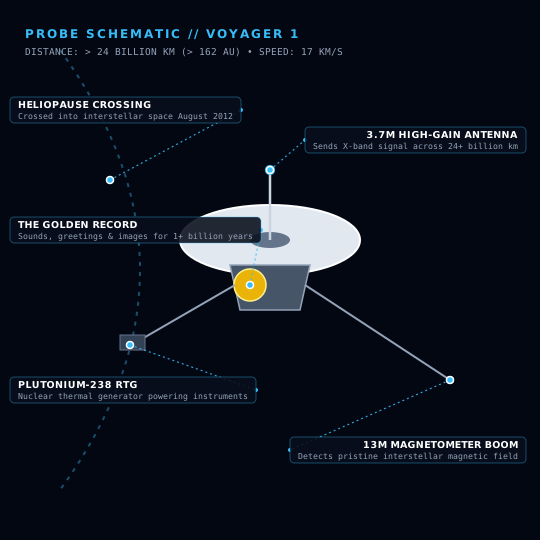
VOYAGER 1 & THE OORT CLOUD
Traveling at 61,000 km/h, Voyager 1 is the farthest human-made object from Earth. Having crossed the heliopause into true interstellar space, it drifts among the trillion comets of the distant Oort Cloud, carrying a golden message from humanity.
- ✦ The Golden Record contains sounds of ocean waves, bird songs, greetings in 55 human languages, diagrams of DNA, and musical compositions from Bach to Chuck Berry, designed to last over 1 billion years in the cosmic vacuum.
- ✦ Even at 17 kilometers per second, it will take Voyager 1 approximately 300 years to reach the inner edge of the Oort Cloud, and another 30,000 years to pass completely out of the other side.
- ✦ The Oort Cloud is a colossal spherical swarm of an estimated 2 trillion frozen comets surrounding our Solar System, extending halfway to the nearest star system, Alpha Centauri.
Astrophysical Mechanics & Field Notes ▼
In August 2012, Voyager 1's sensors detected an abrupt drop in solar particles and a dramatic surge in galactic cosmic rays, marking the crossing of the heliopause. For the first time in history, a human instrument was directly sampling the pristine interstellar medium of the Milky Way.
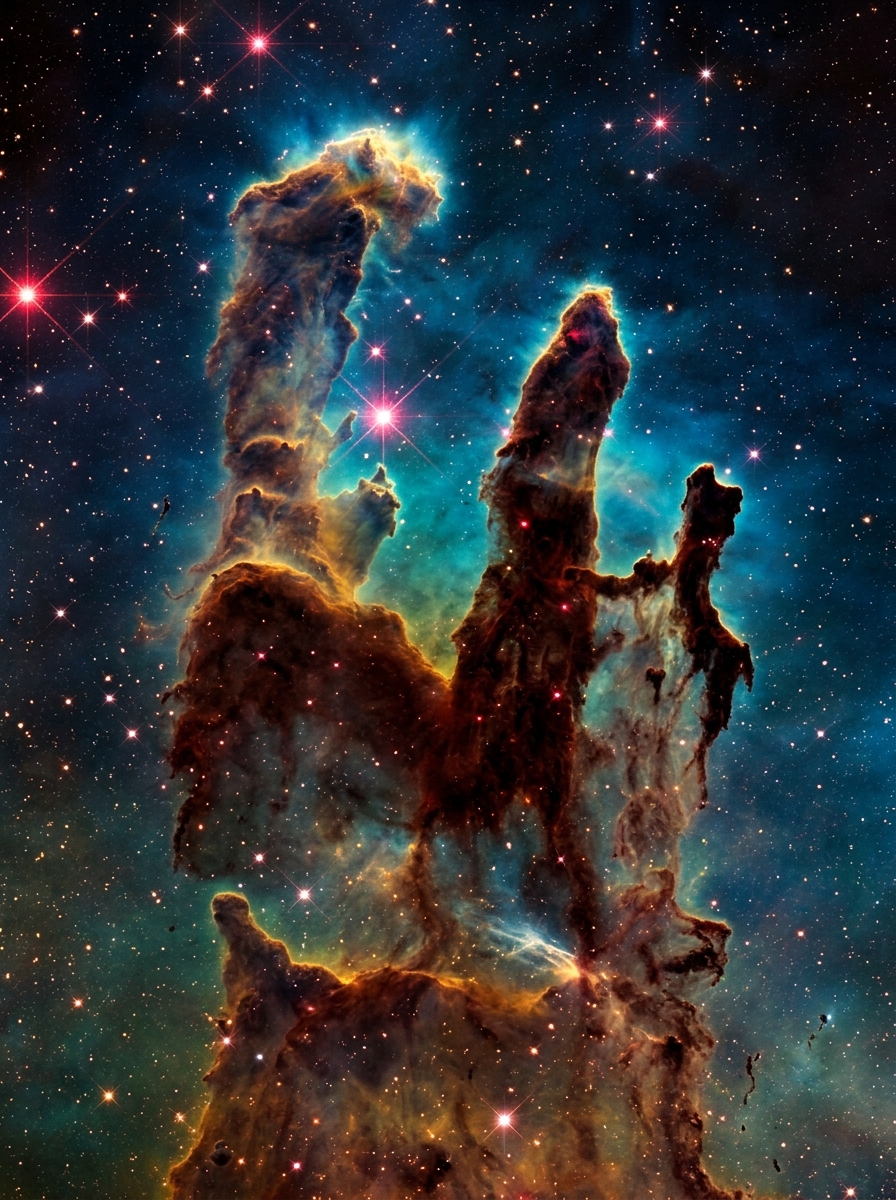
THE PILLARS OF CREATION
Towering light-years above the galactic plane, the Pillars of Creation in the Eagle Nebula are majestic spires of cold molecular hydrogen and microscopic dust. Here, inside dense interstellar cocoons, gravity crushes gas until the fires of new stars ignite.
- ✦ The tallest of the three main pillars is over 4 light-years tall from base to tip — meaning a beam of light would take four full years just to travel the length of this single cosmic cloud.
- ✦ At the tips of the pillars, tiny finger-like projections called EGGs (Evaporating Gaseous Globules) shield newborn protostars that are currently condensing under their own gravitational collapse.
- ✦ Intense ultraviolet radiation from nearby massive young stars is actively eroding the pillars in a process called photoevaporation, carving out these majestic geometric sculptures over millions of years.
Astrophysical Mechanics & Field Notes ▼
Infrared images captured by the James Webb Space Telescope pierce through the dense interstellar dust of the pillars, revealing hundreds of glittering crimson protostars hatching within the hydrogen columns, complete with supersonic stellar jets carving shockwaves through the surrounding gas.
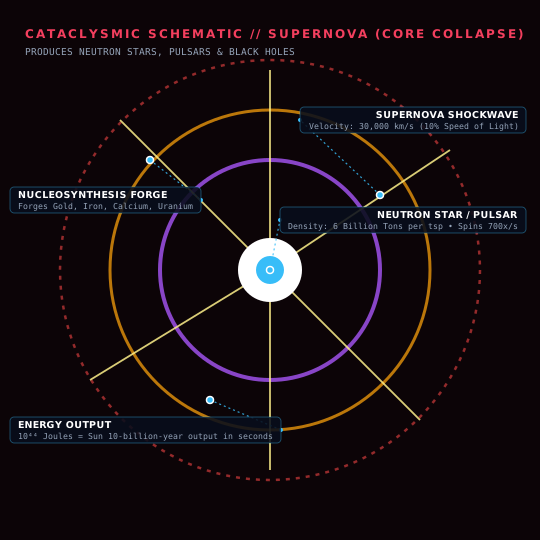
SUPERNOVA & STELLAR DEATH
A supernova is the most violent, spectacular explosion in the universe: the catastrophic collapse of a dying supergiant star. In a fraction of a second, an exploding star outshines an entire galaxy and seeds the cosmos with the chemical elements required for life.
- ✦ Every single atom of iron in your blood, calcium in your bones, and gold in your wedding ring was forged inside the heart of an ancient dying star and dispersed across the void by a supernova explosion.
- ✦ During the collapse of a stellar core into a neutron star, protons and electrons are crushed together with such extreme force that matter is compressed to nuclear density: an entire star squeezed into a sphere just 20 km wide.
- ✦ A spinning neutron star (pulsar) can rotate over 700 times per second, sweeping twin beams of radio radiation across the cosmos like a hyperactive celestial lighthouse.
Astrophysical Mechanics & Field Notes ▼
When massive stars like Betelgeuse (640 light-years away) fuse all their silicon into iron, the nuclear reaction becomes endothermic — consuming energy rather than releasing it. In less than a tenth of a second, radiation pressure vanishes, gravity wins, and the core collapses at a quarter the speed of light.
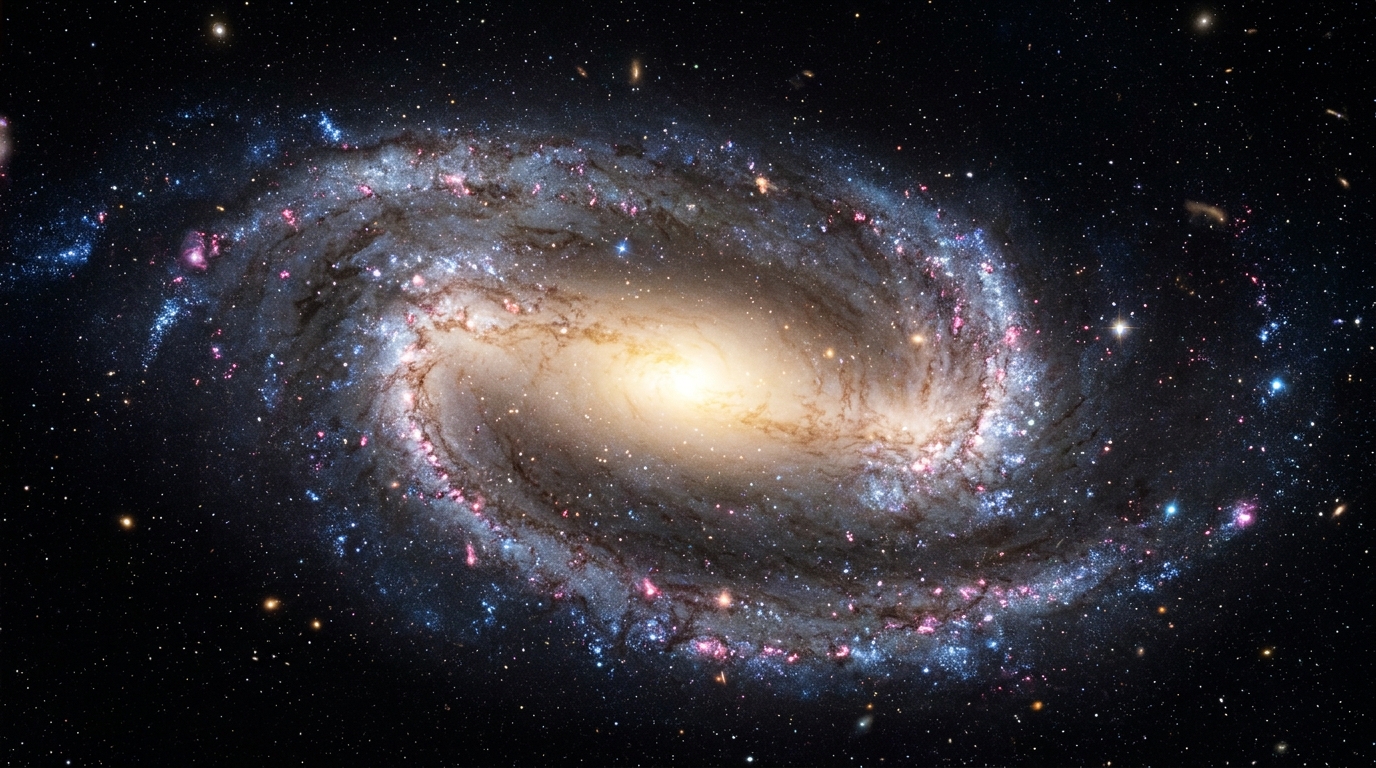
THE MILKY WAY GALAXY
Our home galaxy is an awe-inspiring pinwheel of 100 to 400 billion stars, spiraling through the cosmic ocean. Spanning 100,000 light-years from rim to rim, its sweeping arms are studded with glittering open clusters, glowing nebulae, and billions of alien solar systems.
- ✦ The last time our Solar System was in this exact position in its orbit around the galactic core, dinosaurs were just beginning to walk on Earth (230 million years ago).
- ✦ The Milky Way is hurtling through space on a direct collision course with the neighboring Andromeda Galaxy at 110 kilometers per second. In 4.5 billion years, they will merge into an immense elliptical galaxy nicknamed 'Milkomeda'.
- ✦ Because stars are separated by light-years of empty space, when the Milky Way and Andromeda collide, virtually not a single star will directly crash into another.
Astrophysical Mechanics & Field Notes ▼
Observations of stellar rotation curves by astronomer Vera Rubin proved that outer stars in the Milky Way orbit at nearly the exact same high velocity as stars near the center, defying Keplerian orbital mechanics. This revolutionary discovery proved the existence of an invisible, halo of Dark Matter that makes up 85% of our galaxy's mass.
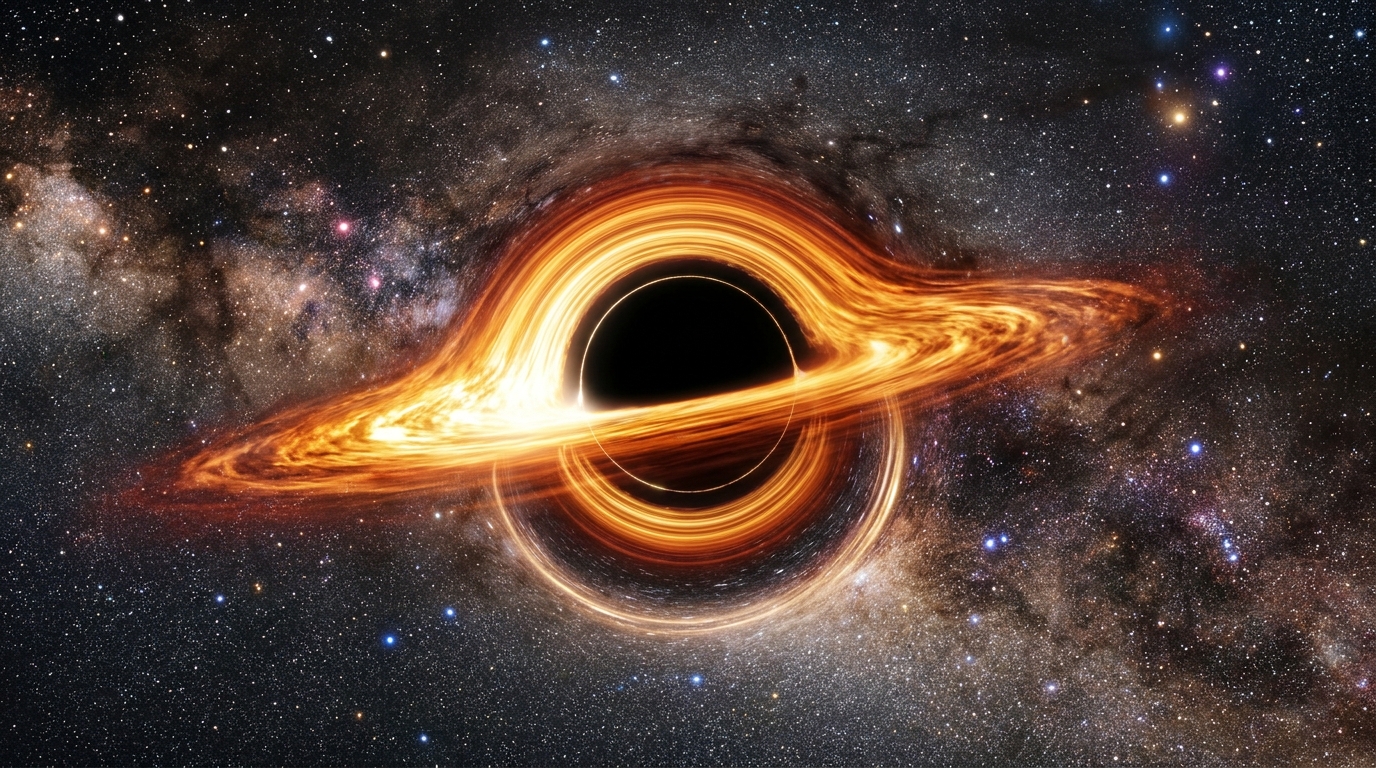
SAGITTARIUS A*
Lurking in the absolute center of our galaxy lies Sagittarius A* — a gravitational leviathan packing the mass of 4.3 million Suns into a space smaller than the orbit of Mercury. Here, the laws of classical physics break down, and spacetime curves to infinity.
- ✦ At the event horizon, the escape velocity equals the speed of light. Nothing — not even photons, information, or matter — can ever cross back outward once it falls within.
- ✦ Due to extreme gravitational time dilation, an observer falling toward the black hole would see their watch tick normally, but a distant observer looking through a telescope would see them slow down, freeze, and fade away into darkness.
- ✦ As matter spirals inward, friction and magnetic shearing heat the low-poly accretion disk to millions of degrees, generating dazzling flares of high-energy X-rays and synchrotron radiation before disappearing forever.
Astrophysical Mechanics & Field Notes ▼
General Relativity predicts that at the center of the event horizon lies a gravitational singularity: a point of infinite density and zero volume where spacetime curvature diverges. Resolving what actually happens at a singularity requires unifying Einstein’s General Relativity with Quantum Mechanics into a unified Theory of Quantum Gravity.
THE COSMIC WEB & THE EDGE
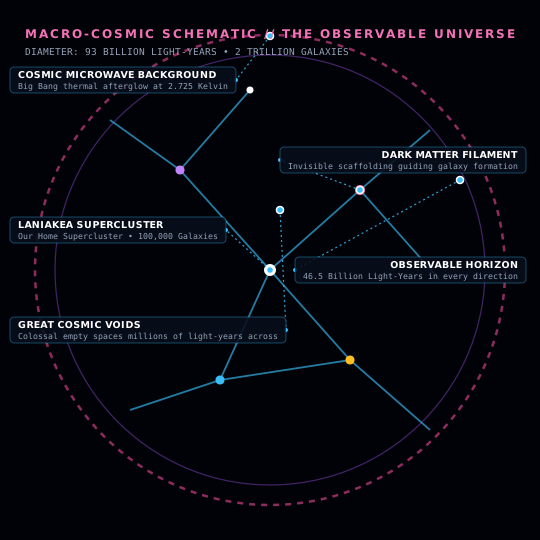
Zooming out to the maximum scale of reality, individual galaxies resemble grains of sand strung along titanic glowing filaments of dark matter and hydrogen gas: the Cosmic Web. Spanning 93 billion light-years across, this is the grand architecture of existence.
- ✦ The universe has no physical edge and no center. The 'observable universe' is simply a spherical bubble centered on each observer, bounded by the distance that light has had time to travel since the Big Bang 13.8 billion years ago.
- ✦ Because space itself has been expanding continuously for 13.8 billion years, the most distant objects we can see have been carried away to a present-day distance of 46.5 billion light-years in every direction.
- ✦ Approximately 68% of the universe consists of Dark Energy — a mysterious repulsive force embedded in the fabric of empty space that is causing the expansion of the universe to accelerate faster and faster every second.
Astrophysical Mechanics & Field Notes ▼
The faint glow of the Cosmic Microwave Background (CMB), discovered in 1965, is the thermal afterglow of the Big Bang itself. Cooled by 13.8 billion years of cosmic expansion to just 2.7 Kelvin above absolute zero, the CMB reveals microscopic quantum fluctuations in the baby universe that later condensed under gravity into all galaxies, stars, and planets we see today.